What Is Dharma in Buddhism: The Living Heart of the Teaching
What is Dharma in Buddhism? What the Buddha repeated most in the suttas, eight marks that set the Dharma apart from doctrine, and why Nibbana isn't nothing.
MYZA Team · 18 min read
Upd. 10/31/2026Updated Oct 31, 2026

Key takeaways
What is Dharma in Buddhism? Look at what the suttas repeat most often: the texts were kept orally and with redundancy, so errors were filtered out. The core is the four noble truths, the eightfold path, anatta and dependent origination; next come the jhanas, the five hindrances, satipatthana and the seven factors of awakening. By nature the Dharma is whatever leads to dispassion and being unbound, taking a person out of their own myth. The path develops five sides: health, psychology, thinking, values and self-observation. And Nibbana isn't non-existence: it has the taste of liberation.
Picture sifting flour. Lumps, bits of husk, everything extra stays on top and gets thrown out. Only what passes through ends up in the bowl.
You can do the same with faith. Take everything people are expected to believe in Buddhism — doctrines, schools, commentaries, rituals — and run it through a sieve of honest questions. Why do I believe this? On what grounds? Where did this part come from?
Usually logic isn't allowed anywhere near faith. But if you let it in, there are two possible outcomes. Either nothing is left and you are hanging over a void: it happens, and that is exactly where the existentialists started. Or something is left. Something you can actually stand on.
So what is Dharma in Buddhism once you sift it down to the bottom? That is what this article is about. In English the word is usually spelled Dharma; in the old Pali texts it is Dhamma. The answer can be approached from three sides: the texts, the practice and lived experience.
Where do you look for the core of Buddhism?
If you go through philosophy, religions and mystical traditions, the most reliable source on what the Buddha taught turns out to be the suttas of the Pali Canon and their relatives. The same texts survive in the Chinese Agamas, parallel translations from other ancient versions. There are Tibetan versions too, and manuscripts found in Pakistan, in ancient Gandhara.
These texts contain the least of what Nietzsche called the «human, all too human», the stuff invented later. But even the Pali Canon has plenty of later layers. So you need a way to tell the core from the extensions.
Put differently: what is Dharma in Buddhism, and what was added later? Buddhist studies offers several answers. One of the most elegant is to look at how the texts were preserved.
In northern India a large, educated community of disciples formed very quickly. The texts were constantly recited aloud: every two weeks, on the day, monks gathered and chanted them together. And there were more than enough texts — the Samyutta Nikaya alone holds over two thousand.
That redundancy works as protection. Remember the game of telephone: when a phrase travels down a single chain, a mistake survives to the end. But if a hundred people heard the same thing and check it against each other, someone will always say: «Wait, that's not how we heard it.» The error gets filtered out.
That is how it went at the First Council. Venerable Ananda recited the texts before a huge assembly of arahants, people who had reached final liberation. «Five hundred» in ancient Indian usage simply meant «a great many». Anyone could check and correct.
And the texts weren't memorised word for word like a voice recorder, but in blocks of meaning. Anyone who reads the suttas notices that the same descriptions repeat verbatim: the , , the eightfold path. A sutta is built from such blocks the way a wall is built from bricks. The brick, not the wall, is the real unit of meaning. The scholar monk Analayo, among others, writes about this.
«The authentic Dhamma is what the suttas repeat most often.»
This gives a simple and very reliable way to find the core of the teaching. Don't hunt for rare, astonishing suttas «unlike anything else». Take the blocks of meaning that come up most often. That is the core.
It seems the first thing Ananda recited was the Samyutta Nikaya. The other collections were put together later for different jobs: the Anguttara Nikaya arranges texts by number, handy for teaching; the Digha Nikaya gathers long texts out of short ones for telling to lay people. If you count across all four Nikayas, the list shifts a little, but not in substance — mostly the order changes. The Khuddaka Nikaya stands apart and is better used for confirmation.
The core teachings: what the Buddha repeated most
Sort the teachings by frequency and you get three tiers. It's a working map, not dogma, but it clears up a lot.
- First tier
- The four noble truths. The noble eightfold path. Impermanence, unsatisfactoriness and not-self (anicca, dukkha, ) — with anatta as the main point, while the first two mostly lead up to it. Dependent origination with its twelve links.
- Second tier
- The four jhanas, states of deep calm that the suttas describe simply and clearly, with no «absorption» about them. The five hindrances. The four foundations of mindfulness, satipatthana. The seven factors of awakening.
- Third tier
- Metta and the other brahmaviharas; contemplation of the unattractive (asubha) against sensual passion; the three roots — greed, hatred, delusion; wise attention (yoniso manasikara); restraint of the senses.
Strictly speaking, the necessary and sufficient condition for liberation is the four noble truths alone. Everything else follows from them. Understand them deeply enough and you could work out the rest yourself. The list is just more convenient.
Curiously, some topics that loom huge in modern Buddhism take up a tiny space in the suttas. Metta comes up noticeably less often than the core, and its importance today is greatly inflated: it's a pre-Buddhist practice, a good one, but supporting. Of the four brahmaviharas only equanimity appears often, and it matters outside the brahmaviharas too. Compassion and sympathetic joy are rare.
And much of what people ask about most — say, how to practise the kasinas properly — barely appears in the suttas at all. These topics gained weight many centuries after the Buddha, when Mahayana and Theravada split and commentarial traditions grew. So it makes sense to stay close to the core and not scatter.
What are the four noble truths?
There is dukkha: unsatisfactoriness, suffering. It has a cause: craving, which grows out of clinging, out of the sense of «me». There is a way out of that craving. And there is a path out: the eightfold one.
The noble eightfold path
Right view and right intention are wisdom. Right speech, right action and right livelihood are ethics. Right effort, right mindfulness and right concentration are meditation.
Right mindfulness is satipatthana: watching what happens in body and mind and calling things by their names. Right concentration is the four jhanas. In a calm, collected mind, insight into impermanence, unsatisfactoriness and not-self takes place. How that works is covered in What is vipassana.
Sometimes the path is shortened to three parts: wisdom, ethics, meditation (panna, sila, samadhi). That shortcut does exist in the suttas, but it shows up a handful of times. The path itself doesn't compress: each factor has its own place.
Dependent origination in real life
The links from contact to clinging aren't theory. You can watch them right now.
You're waiting in line at the pharmacy. Calm, minding your own business. Then someone walks around you and steps up to the counter first. Contact: you saw it. Feeling: unpleasant. Craving: push it away, restore justice. Clinging: you replay it again and again, like a cough drop rolling around your mouth.
And now you're a different person from a minute ago. Becoming has happened. That's the mechanism on the scale of minutes. The tradition says the same mechanism works on the scale of rebirths: at the root lies ignorance, the sense of «me», which charges actions, and consciousness keeps getting stuck to new experience.
Try it right now
Catch the chain
- Recall a recent small grievance: in a line, in a chat, on the road.
- Find the moment of contact: what did you see or hear?
- Notice the feeling «unpleasant» and the pull: what did you want to do?
- See how many times you replayed it afterwards. Just notice, without judging.
How an awakening mind develops
The seven factors of awakening describe the same path from the inside. First mindfulness: for example, knowing the in-breath and out-breath. Then investigation of mental states: you see where distraction is, where a hindrance is. If practice goes on without forcing yourself, energy appears, a calm wish to keep going.
Energy gives rise to quiet joy. Joy is still a light excitement, so tranquillity follows: the mind settles and turns clear. Then concentration — samadhi, the state of jhana. And finally equanimity: the mind stops clinging.

What is Dharma in Buddhism by nature: eight marks
That list is the teaching's skeleton. But there is a deeper question: what is Dharma in Buddhism at its root, by its very nature? Here, unexpectedly, the Buddha himself helps.
In Anguttara Nikaya 8.53 he gives a simple test. If you know of something that it leads:
- to dispassion, not to passion;
- to being unbound, not to being bound;
- to shedding, not to accumulating;
- to few wants, not to many;
- to contentment, not to discontent;
- to seclusion, not to the crowd;
- to aroused effort, not to laziness;
- to being easy to support, not to being demanding —
— then you can know for certain: this is the Dhamma, this is the Vinaya, this is the Teacher's instruction.
You might think all of this exists in many other teachings. Christian asceticism, for example: dispassion, few wants, seclusion. So where's the difference?
Being unbound
The difference is in the second mark. Being unbound (visamyoga). The bonds tie you to a particular state, to becoming, to the world. In modern language, to a myth.
Almost every tradition asks you to accept a particular picture of the world and keep reinforcing it: repeat it, convince yourself, write it in. And a person becomes a resident of their own TV series.
Everyone has their own. One person lives in a series where they're the good guy and everyone in the way is a villain. Another lives in a series about a great nation. A third in a series where their religion is the only true one. A fourth in a series where the Dhamma is the only correct teaching, made of such-and-such dogmas. Samsara is, in large part, a huge streaming catalogue of such series.
«Right view isn't the right doctrine. It's the right stance: stepping out of your own series.»
The mystical branches of many religions have built up a vast experience of self-observation and real wisdom. They contain almost all eight marks. One is missing: being unbound. There a person, on the contrary, writes themselves more firmly into the myth. From a Buddhist point of view these are decent bonds, far from the worst. But they are bonds.
The Buddha himself spoke of letting go of all views, all attachment to standpoints. And that applies to Buddhist schools no less. Theravada has its own set of «episodes» — the Abhidhamma, the Visuddhimagga. Some are sure Nibbana is total non-existence, others that it's a special world. Either way, it's the same attachment to a myth.
This opens an interesting way to look at practices from other traditions. Take tonglen from Tibetan Buddhism. Taken literally — we breathe in other people's bad karma, transform it inside and breathe out bliss — it's impossible by the teaching on karma: karma doesn't work like that.
But strip off the myth and a wish remains: «May the world's pain be transformed in me, may all beings be happy.» And a wish is an intention, which is karma. It is essentially loving-kindness practice, and in that form it works beautifully.
The Dhamma isn't tied to doctrine at all; by its very nature it is untied from it. A good example is Dmitry Likhachev, a Russian scholar who survived Stalin's camps, and his book «Letters About the Good». Likhachev was apparently a Christian, and a thinking one. But check the book against the eight marks and nearly everything matches, except that there's no meditation in it. Seen this way, Christianity itself and the figure of Christ look different too.
Or Anton Chekhov. A doctor who knew he was terminally ill with tuberculosis. Knew better than most what that meant. And he went on treating patients, writing, helping build schools. It's easy to imagine him on a bench in Yalta thinking: «Let it be worse for me, as long as there's less suffering in the world.» There is more Dhamma in that than in many correct quotations.
Five sides of the path
If you look at what grows in a person on this path, it helps to name five sides. They only work together.
- 1
A healthy nervous system
The most basic side is psychiatric and neurological health. Lifestyle belongs here too: do we get enough sleep, enough movement. Some disorders get badly in the way of growth, and most of them can be treated fairly well today, often with medication. People often neglect this.
- 2
Psychological health
Traumas, illusions about yourself and your path. Sometimes the symptoms of an illness get taken for a spiritual experience: it's a nicer way to see yourself. Illness is a job for doctors; how you see yourself and your life is a job for a therapist. On this axis a person moves toward sanity, kindness and the highest models of behaviour, such as the figure of Christ as a living reference point, even without believing the dogmas.
- 3
Thinking
The ability to think soberly and logically. Most people think emotionally: whatever feels nice is right. This is about honesty with yourself and drawing conclusions.
- 4
Values
What matters to me? At first, often only my own wallet. Then that things go well not only for me. Then an interest in something bigger. And in the end the Dhamma, not as «Buddhism», but in the sense of those eight marks.
- 5
Self-observation
Meditation as the Buddha meant it: honestly watching the body as body, feelings as feelings, mind as mind. Pain is pain, not the work of dark forces. A pleasant sensation is just a pleasant sensation, not divine grace. A heavy state, looked at closely, may turn out to be depression rather than a lofty longing for God.
Meditation is an umbrella word, and very different practices hide under it. Some hard-concentration techniques, such as staring at a candle flame for a long time, can make psychological problems worse in some people or become a cover for them. How to choose your values and why practise at all is a separate article.
If one side limps, the others stall. With serious psychological problems, for instance, self-observation is unlikely to do harm, but it won't do much good either: blind spots appear, some things are seen crooked.
How do you know there are no serious problems? There are a few signs. You don't get stuck in negative states: after stress you suffer for a while and come out. There are no dark moods without a cause. In meditation calm comes fairly quickly, and thoughts don't run in a solid, compulsive stream — you can notice them and let them go one at a time.
Most people aren't like that. And even a healthy state needs looking after. In the fifth sutta of the Majjhima Nikaya, Venerable Sariputta compares the mind to a bronze bowl: if you don't clean it and look after it, it gets covered in grime. Life is full of things that wear down the psyche, and without care they take their toll.
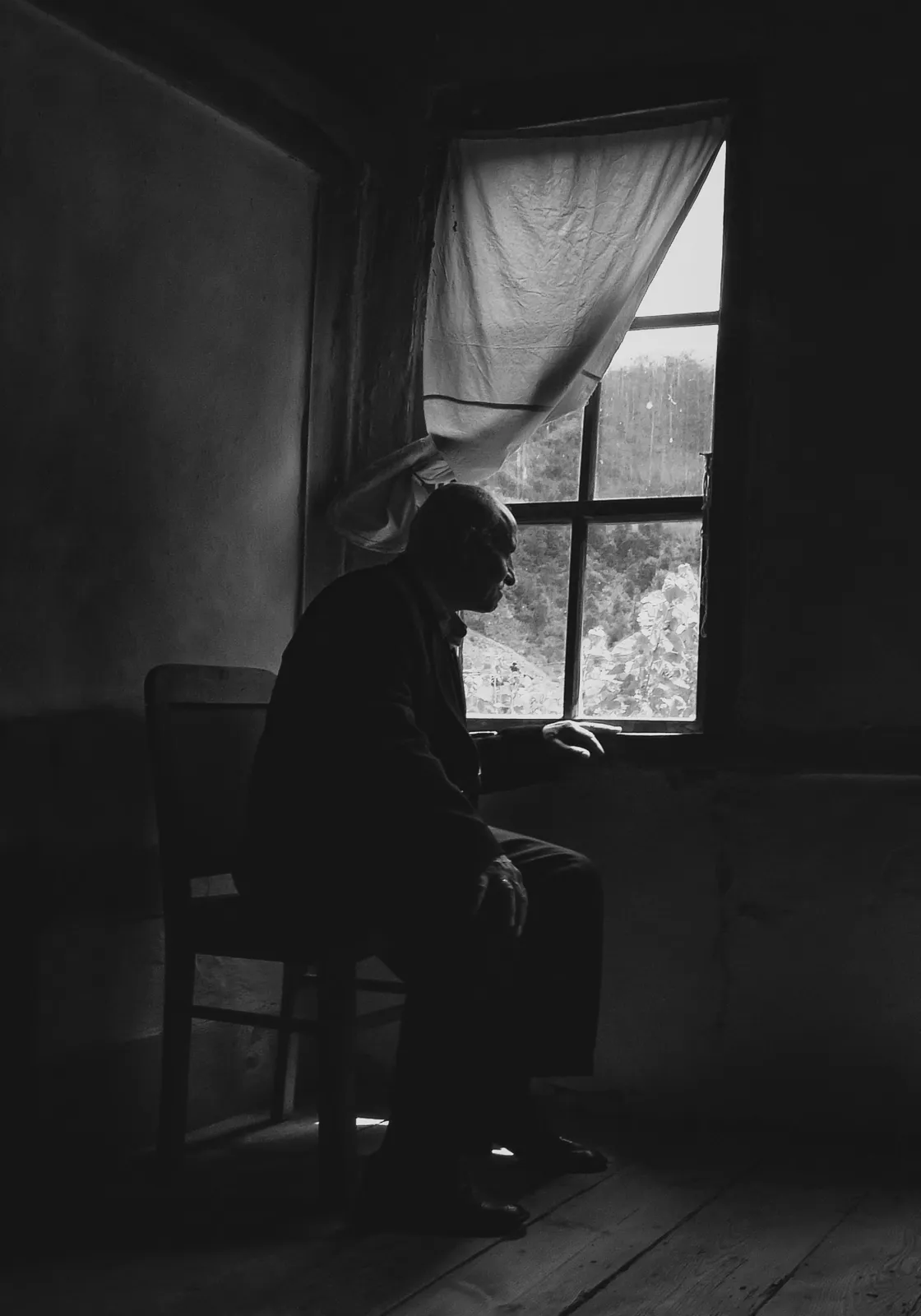
What remains of the Dharma at the edge of death?
Everything above is also a construction. It can go through the same sieve, and it will burn the way beautiful philosophical systems built in the head always burn. So what stays at the bottom?
Dmitry Likhachev recalled an episode from the Solovki prison camp. One evening people were being shot from a list. Likhachev was on that list, but that evening he happened to be hiding in a woodshed, looking for some solitude. They didn't find him and shot someone else instead. After that he decided to live as if every new day were borrowed from that man. And it seems that was when he felt a special depth to the world.
Sometimes a person ends up on the threshold of death themselves: a serious illness, a hospital ward, a clear sense that this is probably it. And at that moment they suddenly see that all the doctrines, schools and correct views mean nothing now. Human, all too human.
But something remains. Something hard to put into words. Living virtue. Purity as such. Let everything vanish, let there be no rebirths, let this be the last minute — but right now you can bear witness to your devotion to it. Some people in such moments silently repeat verses of the Dhammapada, and the verses suddenly come alive.
At the threshold of death, doctrines mean nothing. Living virtue does.
You can't be devoted to mental constructions, even the most elegant ones. Nor to non-existence. If Nibbana is understood as total non-being, the path turns empty: it can't give birth to love or devotion. Yet devotion is there, and there is a taste.
The Buddha kept speaking of vimutti rasa, the taste of liberation. Just as the ocean has one taste, the taste of salt, his teaching has one taste, the taste of liberation. We don't know what liberation is. But we can say for sure that it has a taste.
And when such a person recovers and tells dogmatic Buddhists about it, they often rush to fit it into their own myth: «that was karma», «the gods helped». Though if you look at the situation as it is, there's only the threshold of death, a sense of virtue and devotion. Nothing more needs to be invented.
The unborn: Nibbana is
Those who see «Nibbana as non-existence» like to quote the Sabba Sutta (Samyutta Nikaya 35.23): «What is the all? The eye and forms, the ear and sounds, the nose and smells, the tongue and tastes, the body and touch, the mind and ideas. This is called the all.» So, they say, there's nothing beyond the six spheres: remove samsara and nothing remains.
But there is also Itivuttaka 43: «There is, monks, an unborn, unbecome, unmade, unconditioned. If there were not, there would be no escape.» It says «there is», here and now. Words like thunder.
The six sense spheres are not the same as the five aggregates of clinging, that is, a distorted psyche. When the psyche stops being distorted, perception doesn't disappear: arahants go on seeing, hearing, thinking. And they say the unborn is. The Buddha called Nibbana a dhatu, an element. Not a being, not a world, not becoming — but not an absence either. Something unsayable that has a taste.
Logic has Gödel's incompleteness theorem: a complex enough system can't be fully described by its own axioms. If samsara were a closed system, the whole psyche would come down to clinging and defilements, and a person would be just an automaton, like an NPC in a video game. Then practice would be impossible too: you'd have to pull yourself out of the swamp by your own hair. But samsara isn't closed. Experience suggests the same: not everything in us is a product of the defilements.
This unsayable thing shows up in us as wholesome qualities. If you take the words «God is love», strip away the idea of a person, a supreme being, and read them as pointing to the unsayable that shows up in us as love and wisdom, the formula turns out to be fairly accurate.
Nibbana as non-existence
There's nothing beyond the six sense spheres
Nibbana in the suttas
There is an unborn, unconditioned (Itivuttaka 43)
Nibbana as non-existence
Liberation is total disappearance
Nibbana in the suttas
Perception remains: arahants see, hear and think
Nibbana as non-existence
The path leads into a void
Nibbana in the suttas
Liberation has a taste — vimutti rasa

What the Dharma looks like in daily life: examples
The four truths and being unbound sound lofty. In practice they usually look very ordinary.
- A fight in the building group chat
- A neighbor wrote something snide. Contact, unpleasant, the urge to answer, and now you're typing your third message. Notice the chain at the second link and there's no fight. That's dependent origination in its purest form.
- The coworker «villain»
- For a week it seems they do everything to spite you. Then it turns out their mother is ill. The series where you're the good guy and they're the bad guy switches off for a minute.
- A heavy morning for no reason
- Instead of looking for a spiritual meaning in it, get some sleep, go for a walk, and if it goes on for months, see a doctor. That's the path too.
- Arguing about whose school is right
- You can argue until midnight about Theravada and Zen. Or you can ask yourself: does this argument lead to dispassion or to passion?
- Helping and telling no one
- Driving a neighbor to the clinic and not thinking about merit. There's more living virtue in that than in a hundred correct quotes.
- And this isn't the Dharma
- Being proud of how many retreats you've done and looking down on people who «don't practise». The technique is Buddhist; the bonds are perfectly ordinary.
Check yourself
Is this the Dharma or not?
You meditate every day and are proud you've got further than your friends.
You've stopped arguing about whose school is right and watch yourself more.
Someone of another faith lives simply, helps people and doesn't cling to being right.
You practise because you're afraid of bad karma.
Instead of a conclusion
Run Buddhism through a sieve of honest questions and the schools, commentaries and arguments about whose doctrine is right stay on top.
What passes through is not much: four truths, a path, being unbound. That is what Dharma in Buddhism is, once nothing extra is left.
And a taste. The taste of liberation, which you can stay devoted to until your last breath.
A question to reflect on
What series about yourself are you watching? And who would you be if you switched it off for a minute? For a week, try noticing one story you keep telling yourself about yourself.
Frequently asked questions
What is Dharma in Buddhism, in short?+
In the suttas the Dhamma (Dharma) is the Buddha's teaching, and its core is what the texts repeat most often: the four noble truths, the eightfold path, impermanence, unsatisfactoriness and not-self, and dependent origination. By its nature, according to Anguttara Nikaya 8.53, Dharma is whatever leads to dispassion, being unbound, few wants, contentment, seclusion and effort.
How do you tell the Dharma from mere doctrine?+
Use the eight marks from Anguttara Nikaya 8.53. The key one is being unbound: the Dharma takes you out of attachment to a myth instead of strengthening it. Even Buddhist techniques stop being Dharma if they feed pride in progress or fear.
Is Nibbana total non-existence?+
The suttas say otherwise. Itivuttaka 43: «There is an unborn, unbecome, unmade, unconditioned», otherwise there would be no escape. The Buddha called Nibbana an element (dhatu). It's not a being or a special world, but not an absence either: something unsayable that has a taste, the taste of liberation.
Can the eightfold path be shortened?+
It is grouped into three parts — wisdom, ethics and meditation — and that grouping does appear in the suttas, but very rarely. The path itself doesn't compress: each of the eight factors has its own meaning.
Does a practitioner need a therapist or psychiatrist?+
Often, yes. Psychiatric and psychological health are two of the five sides of the path, and without them self-observation stalls. Signs there are no serious problems: you don't get stuck in negative states, dark moods don't come from nowhere, and in meditation the mind settles fairly quickly. If that's not you, see a good specialist with any problem and the thread will start to unravel.
MYZA App
MYZA is a meditation app: a timer with gongs, a practice journal, short courses on meditation and Buddhism, and a guide who helps you make sense of your practice.

Was this article helpful?
New articles by e-mail
One letter with a new article every few weeks. No ads; unsubscribe in one click.
Read also

Nov 2, 2026·10 min read
Merit in Buddhism: Ten Ways to Make Good Karma
Merit in Buddhism explained: generosity, virtue, meditation and seven more meritorious deeds that lead to good karma and leave a quiet joy behind.

Oct 29, 2026·8 min read
Anicca: how to look into impermanence in practice
Impermanence in Buddhism (anicca): how to look into it in practice, the six things from the Dighavu sutta, and why the Buddha left no single technique.

Oct 25, 2026·16 min read
Right Speech: Why It Starts With What You Tell Yourself
Right speech in Buddhism starts with your inner dialogue. Six filters from the suttas, a speech journal and how to calm negative self-talk.