Meditation benefits: what two years of practice taught me
Meditation benefits go beyond focus and productivity. A personal story from two years of practice: how to stop replaying grudges and know when to stay quiet.
Pavel · 12 min read
Upd. 10/31/2026Updated Oct 31, 2026
Key takeaways
Meditation benefits go far beyond focus and productivity. The main thing it gives you is the ability not to be held hostage by your own reactions. An unpleasant moment lasts minutes, yet we replay it for weeks. Regular practice, even 10–15 minutes a day, teaches you to notice emotions and thoughts without falling into them. Then a pause appears between an event and your reaction, and with it a choice: stop replaying the grudge, skip the pointless argument, stay quiet in time. Wisdom is built from these small choices.
Sometimes an unpleasant moment lasts just a few minutes, and then we live through it for weeks, months, sometimes years.
The moment itself is long over. But in our heads it keeps playing — like an episode someone set on repeat.
I've been meditating for a couple of years now. And if you asked me today about the real meditation benefits, my answer would be very different from the one I'd have given at the start.
Meditation benefits beyond productivity
When people talk about the benefits of meditation, it's usually the same list: focus, attention, memory, handling emotions, productivity.
It's often sold as a tool: work smarter, grow your business, make better decisions and, in the end, earn more.
Maybe for some people that really is the main value. I won't argue — a clear head at work never hurt anyone.
But for me personally, I found something far more important.
Meditation slowly teaches you not to be held hostage by your own reactions to what happens.
And that, I think, is where it gets interesting.
It happened once — we relive it a hundred times
Life keeps happening. There are good moments and bad ones. We get lied to, we lose things, we fail, we run into unfairness, or we simply hear one sentence that cuts deep.
And how does the mind usually react?
We get angry. We get upset. We replay the conversation. We come up with what we should have said. We look for someone to blame, argue in our heads, prove we were right.
Sometimes the event no longer affects our life at all, yet we keep going back to it and feeling the same thing all over again.
In the Monday meeting your manager called your report half-baked in front of everyone. The meeting took forty minutes; the comment took ten seconds. That evening you're in the shower delivering, for the fifth time, the speech you never gave — with numbers, arguments and a killer closing line. Meanwhile your manager is watching the game and has long forgotten the whole thing.
It's a strange thing: the event happened once, yet we live through it dozens, even hundreds of times.
And in those moments we rarely notice what's going on. It feels like we're just thinking it over, figuring it out, looking for a solution. Often, though, we're no longer solving anything — we're just walking in circles inside our own feelings.
«The event lasts minutes. The replay in your head can run for years»
Mindfulness: no fewer emotions, just clearer to see
That's where I started to notice a quality that grows with meditation — mindfulness. Not so much while I'm sitting in silence with my eyes closed, but in everyday life. Especially when something goes wrong.
Getting angry, upset, deeply disappointed — all of that still happens. Meditation doesn't make anyone bulletproof, someone nothing can touch. And honestly, I don't think that's the point.
The difference is somewhere else. At some point you start noticing not just the emotion itself, but how it unfolds inside you.
I notice that I'm angry right now. I notice my mind pulling back to the unpleasant moment. I notice the thoughts showing up, the urge to blame someone, to prove something, to reply right now.
And instead of diving in headfirst, there's a chance to step back a little and simply watch what's happening.
Not pushing the emotion down. Not telling yourself it's no big deal. Not forcing yourself to calm down this instant.
Just admitting it: yes, this is unpleasant. Yes, it hurt. Yes, right now I feel anger, resentment or disappointment.
And seeing what happens next.
Sounds similar, but no
Watching an emotion means suppressing it
What it really is
The emotion stays — you just stop feeding it new thoughts
Sounds similar, but no
A mindful person is always calm
What it really is
You can be angry and still see that you're angry
Sounds similar, but no
Letting go means convincing yourself nothing happened
What it really is
Letting go means admitting it hurt and no longer replaying it
Here's what I've noticed: when I manage not to feed a feeling with endless thoughts, it gradually loses its grip. Things that used to throw me off balance for a long time now sometimes let go much faster. In a day, sometimes two or three.
Of course it depends on the situation, and not every feeling fades that quickly. But the way you relate to what happens slowly changes.
Feeling a painful emotion is one thing. Continuing to live inside it after the event is over is something else entirely.
Why meditate if you can just be mindful?
Because in a moment of strong emotion the mind does what it's used to, not what we promised ourselves.
On paper it's simple: notice the emotion, watch it, don't react on autopilot — done.
In practice it's much harder.
If for years you've trained your mind to snap, take offense, worry and go back to unpleasant things again and again, then in a moment of strong emotion the wish to "be mindful right now" usually isn't enough. It's like deciding to learn to swim in the middle of a storm. People learn in a pool, when the water is calm.
The mind does what it's used to doing.
That's why, in my view, regular practice matters so much. Even if it's just ten or fifteen minutes a day: you sit, watch your breath, thoughts and sensations, and learn to notice how attention keeps wandering off. If you're just starting out, here's how to meditate without overcomplicating it.
At first it feels like nothing special is happening. A thought comes, goes, you drift off, you bring your attention back. Drift off again. Come back again. In ten minutes the mind can plan a vacation, argue with a neighbor and wonder whether you left the stove on.
But, as I understand now, this is one of the most important parts of the practice. You're training the ability to watch what's happening inside without automatically falling into every thought or emotion.
And over time that skill starts showing up in everyday life. Sometimes in the most unexpected, seemingly small moments.
Try it right now
One minute of noticing
- Sit comfortably and close your eyes or lower your gaze.
- Follow your breath: in, out.
- When you notice you've drifted into thought, silently say "thinking" and come back to the breath.
- At the end, recall how many times your attention wandered. Every "noticed it" is the training itself.
Mindfulness as a path to wisdom
And this brings me to the idea I find most interesting.
Mindfulness isn't only a way to deal with difficult feelings. It's also one of the paths to wisdom.
Buddhist tradition puts great weight on three qualities worth developing throughout life: generosity, morality and wisdom.
Wisdom used to seem rather abstract to me. A deep understanding of life, a store of knowledge, philosophical reflection, the ability to give good advice. Something for a gray-bearded sage on a mountaintop.
But gradually I began to see that real wisdom shows up in much simpler things. Literally every day.
Like staying quiet when you can stay quiet.
Not getting into a pointless argument, even when you badly want to prove you're right. Not criticizing someone just because you didn't like something. Not filling the air with empty talk when there's no need. Not having to put your two cents into every conversation.
What could be easier? Just hold your tongue.
But if you watch yourself closely, you'll notice something interesting. How often there's an almost automatic urge to comment, correct someone, judge, interrupt, give advice nobody asked for, or just throw in your two cents.
In the family group chat your sister mentions she's flying to Lisbon with a layover in Newark. Your fingers are already typing: "You should connect through Boston, it's way easier, we did that two years ago…" Nobody asked, and her tickets were booked a month ago.
And we don't always stop to ask why we're about to say it at all.
Are these words really needed right now? Will they help in any way? Will they make the situation clearer? Or are we just following a familiar impulse once again?
That's where mindfulness shows up. You notice the urge to say something, but you no longer have to follow it right away. A small pause appears, and in it you can decide whether to open your mouth at all. Much of the Buddhist teaching on right speech is about exactly this.
Of course this isn't about always keeping quiet, avoiding hard conversations, putting up with unfairness or being afraid to speak your mind. Sometimes saying something directly, honestly, even harshly, is exactly what's needed.
But a huge share of our words come out not because they're needed, but because we're used to reacting to everything.
And sometimes the wisest choice is to say nothing at all.
«Wisdom shows not only in what we do and say, but in the needless words and actions we manage to skip in time»
And from the outside nobody may even notice. No one will know that you could have jumped into an argument, said too much, hurt someone or damaged a relationship — but stopped in time.
For everyone else, nothing happened. For you, it can be a small but very real win over the habit of reacting on autopilot.

How meditation, mindfulness and wisdom connect
The more I think about it, the clearer I see the chain:
- in meditation we learn to observe;
- thanks to that, we start noticing our thoughts, emotions and impulses in everyday life;
- once we notice them, we have the option not to follow them automatically;
- and when there's a choice, we make wiser, more balanced decisions.
Isn't that, at least in part, what wisdom is?
One thoughtless remark can ruin a relationship. One act in the heat of the moment can wreck what took years to build. One rushed decision can lead to consequences you regret for a long time.
And the other way around: sometimes it's enough to notice your state in time, stop and do nothing — and a whole pile of unnecessary trouble simply never happens.
So mindfulness changes not only how we relate to our own feelings, but how we deal with people and the world around us. We react on autopilot less and notice more often that we actually have a choice.
Between an event and our reaction there is a small pause. Meditation teaches us to notice it, and in that pause a choice appears.
For me, this has been one of the most valuable discoveries of these two years of practice.
What two years of practice taught me
I can't say I now always act mindfully, never get irritated, never say too much and easily let go of anything unpleasant. Of course not. Old habits don't disappear overnight, and sometimes I get swept up by emotions just the same and only notice afterwards.
But now at least I see the process itself far more often. And sometimes I manage to catch it before I say or do something.
That's why meditation is no longer just an exercise for focus or productivity for me. More and more I see it as a practice that helps me understand my own mind, not be held hostage by every emotion, and slowly learn to live a little wiser.
Maybe some people get here much faster. Some find something completely different in meditation. Everyone has their own experience and their own path.
But if we're talking about what meditation has given me personally, it's above all the growing ability to notice the moment when, between an event and my reaction, a choice appears.
And the further I go, the more it seems to me that what we call wisdom is made of exactly these small choices.
Meditation benefits in everyday life: examples
Here's what that pause between event and reaction can look like on an ordinary day.
- Your delivery is an hour late
- You want to fire off a long, furious message to support. Mindfulness is noticing that anger is already writing it for you, and deciding whether you need it at all or a short complaint will do.
- Your teenager slams the door
- Your first impulse is to go and deliver a lecture about respect. The pause helps you see that any lecture right now will only pour fuel on the fire, and to come back to the talk in the evening.
- A coworker takes credit for your idea
- All evening your mind replays what you should have said in the meeting. You can notice the replay and calmly decide what to do tomorrow, instead of reliving the meeting for the hundredth time.
- An argument in the comments
- A stranger posts complete nonsense and your fingers are already typing a reply. You can notice the impulse and close the tab: the world won't end, and your evening stays yours.
- Your mother-in-law critiques your Thanksgiving turkey
- Irritation pricks inside. You can notice it, smile and skip round twenty of the same old argument — the turkey won't taste any better for it.
- And this isn't mindfulness
- Staying silent while someone else is being treated badly in front of you and calling it "just not reacting." The pause is there to choose a response, not to give up on one.
Check yourself
Is it mindfulness or not?
You got angry at a friend, noticed it and decided to reply tomorrow, once you've cooled down.
You act like nothing bothered you, while inside you're boiling for a week.
You wanted to correct a coworker in front of everyone, but kept quiet because the mistake didn't matter.
You never argue, even when you're treated unfairly.
Instead of a conclusion
Sometimes the most important thing you can do in life is to not say too much in time, not give in to an emotion, and not do something you'll regret later.
And maybe that's a far more valuable gain than working even more efficiently or getting more done.
Meditation doesn't switch off the show in your head. But it puts the remote in your hand. And more and more often I remember it has a pause button.
A question to reflect on
If for a whole week you said nothing unnecessary, what would change in your life? What would you lose, and what would you keep? For seven days, try noticing the moment you want to throw in your two cents, and at least once a day ask yourself: are these words really needed right now?
Frequently asked questions
What are the real benefits of meditation, in simple words?+
It helps you notice your reactions before they start running you. Meditation trains attention: you learn to see thoughts and emotions without falling into them. In daily life this becomes a pause between an event and your reaction, where you can choose what to do.
What does meditation give you besides focus?+
It helps you stop replaying unpleasant situations for weeks. Anger and resentment don't vanish, but you can see them, and without new thoughts to feed them they lose their grip faster. Over time your whole relationship to what happens changes.
Can you be mindful without meditating?+
In theory, yes; in practice, it's hard. If you've trained your mind for years to react instantly, the wish to be mindful usually isn't enough in a moment of strong emotion. Regular practice, even 10–15 minutes a day, trains the skill in quiet so it works when things get tough.
Does meditation make you indifferent?+
No. You can still get angry, upset or disappointed. The difference is that you notice the emotion and how it unfolds, and you don't have to follow it right away. It's not suppressing feelings — it's being able to choose your response.
How is meditation connected to wisdom?+
In meditation we learn to observe. Observing helps us notice thoughts and impulses in everyday life, and what we notice we no longer have to act out on autopilot. A choice appears, and decisions become more balanced: staying quiet in time, skipping an argument, not doing what you'd regret.
MYZA App
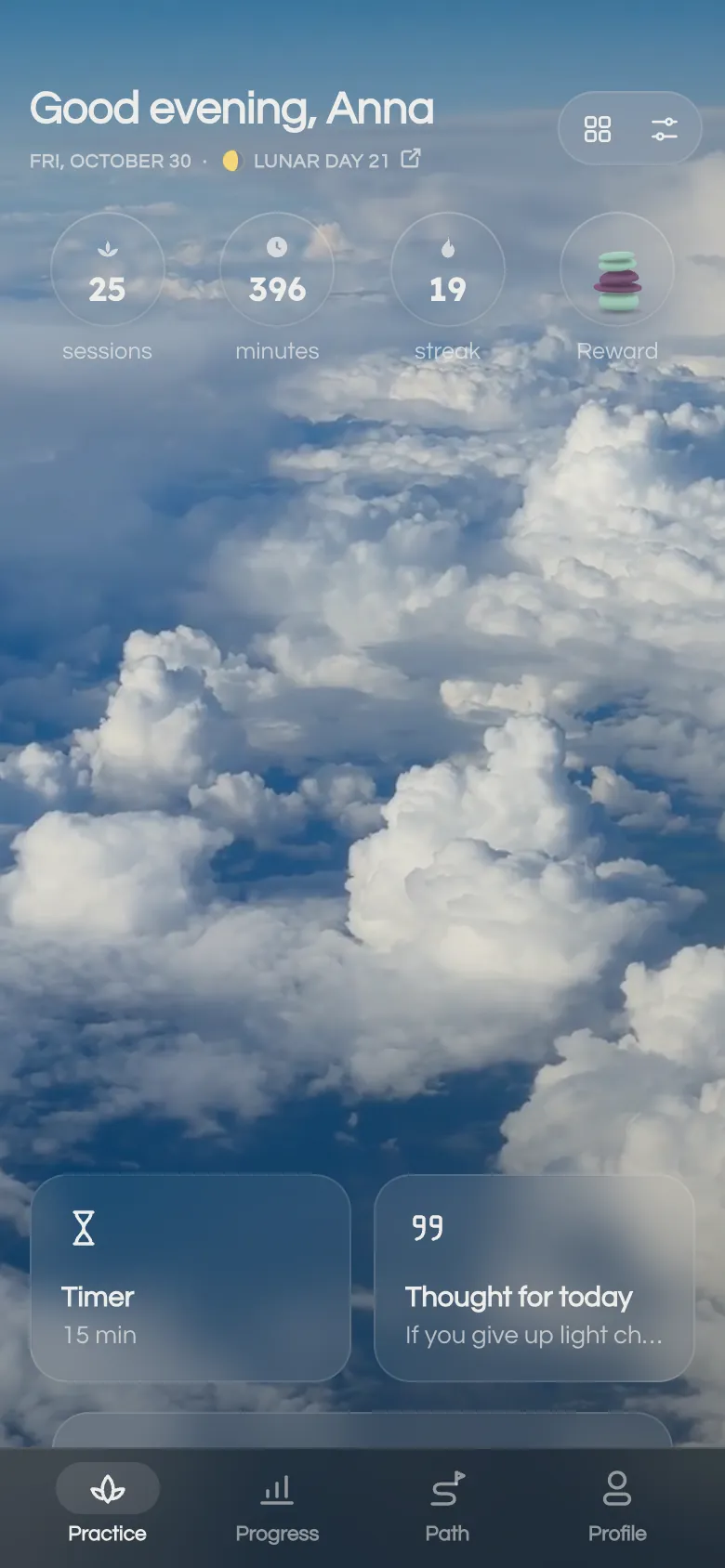
MYZA is a meditation app: a timer with gongs, a practice journal, short courses on meditation and Buddhism, and a guide who helps you make sense of your practice.
Was this article helpful?
New articles by e-mail
One letter with a new article every few weeks. No ads; unsubscribe in one click.
Read also

Oct 29, 2026·8 min read
Anicca: how to look into impermanence in practice
Impermanence in Buddhism (anicca): how to look into it in practice, the six things from the Dighavu sutta, and why the Buddha left no single technique.

Oct 28, 2026·14 min read
How to meditate: listen to yourself, not someone else's method
How to meditate: why listening to yourself matters most, where to start from zero, what to do with intrusive thoughts, and which posture to sit in.
Oct 27, 2026·18 min read
What Is Dharma in Buddhism: The Living Heart of the Teaching
What is Dharma in Buddhism? What the Buddha repeated most in the suttas, eight marks that set the Dharma apart from doctrine, and why Nibbana isn't nothing.