
How to Stay Calm: Four Simple Phrases for Every Day
How to stay calm in everyday life: four short Buddhist phrases to keep at hand, letting go of over-control, and practice in meditation.
MYZA Team · 11 min read
Upd. 10/22/2026Updated Oct 22, 2026

Key takeaways
How to stay calm when understanding isn't enough and you need practice? Buddhism has short phrases you keep at hand, like keys in your pocket. “Everyone is shaped by conditions” — so you don't judge others; and for yourself: “what happens to me depends on what I do”. “This arose from conditions and will end the same way” — to find and remove the causes. “This isn't me or mine” — so you don't take offence or try to save everyone. “That's how the world works” — so you don't carry the whole world on your shoulders. And in meditation — learning not to react to what arises.
Sometimes a person reads about equanimity, agrees with every word — and an hour later blows up over an unwashed mug in the sink. Understanding isn't enough. It takes practice.
So how to stay calm in real life? Buddhism has short phrases for it. You keep them at hand, like keys in your pocket, and reach for one when something inside starts to boil. What equanimity itself is, and how it differs from indifference, is in «Equanimity». Here — how to train it.
How to stay calm with a few short phrases?
It works simply. Something happens that used to drive you up the wall. You recall the right phrase and look at the situation through it. And the emotion doesn't grip you the same way.
In the tradition these phrases are in Pali, the old language of the Buddhist texts. But the language doesn't matter: you can say them in your own words, as long as they're clear and quick to recall. Here are the four main ones.
- “Everyone is shaped by conditions”
- A person is the result of countless circumstances, not just their own choices. When: you feel like judging someone else or yourself.
- “This arose from conditions — and it will end the same way”
- Everything has causes, and some of them can be removed. When: you feel like a victim of circumstances or “bad people”.
- “This isn't me or mine”
- An event is simply happening. When: you've been hurt or offended, or you feel the urge to rescue everyone.
- “That's how the world works”
- Such is the order of things. When: something looks like a cosmic injustice, or you feel you must have an opinion on everything.
The first phrase: “Everyone is shaped by conditions”
Pali has two similar formulas. “Kammassaka”: everyone is heir to their own actions. “Niyamaka”: everyone is the result of countless conditions. The difference matters.
Apply the first one to everyone — “it's their own fault, it's their karma” — and it's easy to become cold and arrogant. Someone grew up in poverty, believes in conspiracy theories, is ill because of bad habits. Saying “it's their own fault” is cruel: perhaps nobody ever taught them to live differently.
So “kammassaka” is better applied to yourself: what happens to me depends on what I do. That gives responsibility and hope: you can climb out of any hole if you keep doing good. That's all that depends on me. But it's a lot.
And to others — “niyamaka”: a person is shaped by countless conditions, and their choices are only some of them. We don't know what goes on in their head or what their childhood was like.
How not to
To others: “it's their own fault, it's their karma”
How to apply it
To others: they're shaped by countless conditions
How not to
To yourself: “nothing depends on me”
How to apply it
To yourself: what happens to me depends on what I do
What conditions? The tradition names five: where a person was born; the body and heredity; the mind and childhood; their own actions; and the general order of things. In short: a person is more than their choices.
Like a dish. The cook matters. But so does what was in the fridge, what the stove was like, and whether the power went out halfway through.
You can look at yourself the same way. Even the Buddha, according to the suttas, fell ill — and said that not every illness comes from karma: sometimes circumstances just add up that way. And there's no reason to think that because things are good for us now, they'll stay that way. It's humbling. And it makes you more tolerant — of people and of yourself.
The second phrase: “This arose from conditions — and it will end the same way”
In Pali: “idam paticca-samuppannam, tam nirujjhati”. Nothing happens out of nowhere: everything has causes. Find the causes that depend on you — and remove them. Then the result stops too.
Late every morning and angry at the traffic? Traffic is a condition. Leaving home at 8:40 is a condition too. And unlike the traffic, that one can be changed.
This phrase helps you stop being a victim of circumstances and “bad people”. The main question it asks: what can I do so this doesn't happen again?
The third phrase: “This isn't me or mine”
In Pali: “yadidam anatta”. What's happening is simply an event. Not “they offended me”, but this and that happened.
Someone on the subway shoves you with their shoulder. Usually we think: “I got shoved. How rude.” Or you can put it this way: body A bumped into body B. Full stop. It sounds like a physics textbook problem. But try being offended by a physics textbook.
If the person is dangerous, just step away. Or even apologise, though you were the one shoved — if it defuses things. There's no one to blame: the other person is shaped by conditions too. What's left is to see what I can do.
Try it right now
The phrases in a minute
- Recall a recent situation that got to you.
- Describe it to yourself without “I”: what happened, simply as an event.
- Add: “This arose from conditions.”
- When the gong sounds, notice how much emotion is left.

The same phrase helps when you want to save everyone. Every man must. Every woman must. If you're kind, you must save everybody.
We don't demand this of others. Nobody expects the school librarian to step into the ring with a boxer. But of ourselves, somehow, we do: save every dog, sort out the mess in the next department, explain to a friend for the hundredth time that her boyfriend is a jerk. Not everything in the world is your responsibility.
Hence a simple rule: rely only on what depends on you. A goal that depends on others almost guarantees worry.
A conversation. The goal “change your uncle's mind at the holiday table” is doomed. The goal “say what I think, hear him out and calmly finish my salad” is perfectly achievable. And sometimes it turns out the conversation isn't needed at all.
A venture. Someone opens a coffee shop on money friends promised to put in. And if they change their minds? It's calmer to plan from what you have. If they invest — a pleasant surprise.
A goal that depends on others
Win the argument with your uncle at the holiday table
A goal that depends on you
Calmly finish your salad
A goal that depends on others
Open a café on money your friends promised
A goal that depends on you
Plan from what you have; investment is a pleasant surprise
A goal that depends on others
Get the other person to agree
A goal that depends on you
State your view and hear theirs

The fourth phrase: “That's how the world works”
In Pali: “evandhamma” — such is the order of things. Wars, cruelty, and right beside them, someone's kindness. It's been like this all through history. When something looks like evil on a cosmic scale, this phrase reminds you: things like this happen in the world all the time, and this too will pass one day.
There's no absolute evil and no absolute good in the world. The bandit Angulimala killed many people, then became a disciple of the Buddha and reached liberation. One of the Buddha's chief disciples, legend says, killed his own parents in a past life. It seems unfair to us.
«Fairness is a child's emotion. A child's toy is taken away, and he cries.»
This phrase also lifts the duty to have an opinion on everything. Over morning coffee a person manages to form views on the world economy, a stranger's divorce and a series he hasn't watched. By lunch he's exhausted. “That's how the world works” — and you don't have to carry all of it on your shoulders.
This isn't indifference. Even when there's trouble all around and everyone is on edge, you can stay out of the boiling and help those you're able to help. The task is to stay human.
Equanimity is like the old joke. A man comes to a rabbi and complains about another man. The rabbi says: “You're right.” The second man comes with his version. “And you're right.” A witness is puzzled: “How can they both be right?” The rabbi replies: “And you're right too.”

Letting go of over-control
The shortest way to describe equanimity is letting go of over-control. We react where there's no need. And there's no need almost everywhere.
Reacting is an attempt to control what you don't actually control. Like a passenger who presses an imaginary brake the whole way. The car doesn't drive any more safely. The passenger's leg just aches by the end of the trip.
Equanimity in meditation
In meditation this is exactly what we train every day. A thought comes — we let it go and don't feed it. An unpleasant sensation — we don't try to get rid of it. A pleasant one — we don't hold on.
Try it right now
A minute of not reacting
- Sit comfortably and follow your breath.
- A thought comes — note it and don't feed it.
- An unpleasant sensation — don't try to get rid of it. A pleasant one — don't hold on to it.
- If you get drowsy, tell yourself “that's how it is right now” and simply stay with it.
Say today you're drowsy. Okay, that's how things are today. Without equanimity, a person starts fixing the meditation instead of meditating. Like someone who can't fall asleep because they're trying too hard to fall asleep.
On the whole, meditation is accepting what is. No tricks. And little by little you let go of thoughts that once seemed important but were really just instilled in us as children. And not only as children.
Living without hooks
Culture is largely built like this: people agree on what's important and what's sacred, and put that list into the heads of children and adults. When a child is told “shame on you”, that's the same kind of list, just a small one.
Equanimity slowly takes these hooks out. A person realises they don't have to react to everything or feel guilty about anything and everything. They still live honestly and kindly — but no longer out of fear: from the fullness of the heart, by their own choice.
A fan of one team finds it hard to see things from the other side, especially after a disputed penalty. Equanimity teaches you to look from above, rooting for neither side. Then there's nothing to catch on. And hooks always hurt.
A person may share a pastry with a stray dog, and it makes them glad. Or they may not, and it doesn't upset them. The mind stays calm. Some people describe it like this: as if you'd climbed out of a thorny bush and lay down on a soft featherbed.
How to stay calm in everyday life: examples
These phrases work not on the meditation cushion but on an ordinary weekday.
- Late for the third time this week
- Instead of “it's always the traffic” — “this arose from conditions”: traffic is one, leaving at 8:40 is another. The second can be changed.
- A rude cashier
- “Everyone is shaped by conditions”: the twelfth hour of a shift, a bad back, a boss since morning. They're made of conditions — and so are you.
- Missed a deadline again
- To yourself: what happens next depends on what I do now. Not self-punishment — hope.
- An argument in the family group chat
- “This isn't me or mine”: not my area. No need to step in or have an opinion on everything.
- Heavy news first thing in the morning
- “That's how the world works”: help if you can — and don't carry the whole world on your shoulders.
- And this isn't a phrase, it's an excuse
- Saying “that's how the world works” when the electricity bill arrives, and not paying it. The phrases don't cancel what depends on you.
Check yourself
How to stay calm: is the phrase used right?
Someone you know is in trouble, and you think: “it's their own fault, it's their karma”.
You were late for the third time this week, so now you leave home twenty minutes earlier.
Someone shoves you on the subway, and you note: “body A, body B” — and move on.
You've decided you simply must change your uncle's mind at the holiday table.
Instead of a conclusion
These phrases don't make anyone calm in a day. They're like keys in your pocket: at the right moment your hand finds the right one.
How to stay calm? Keep the keys at hand and use them every day.
A question to reflect on
Which of the four phrases is closest to you? In what situation this week will you try it? Write down in the evening how it went.
Frequently asked questions
How to stay calm when everything irritates you?+
Keep short phrases at hand and recall them at the moment emotions used to flare. For example: “everyone is shaped by conditions” — the person irritating you is the result of countless circumstances, just like you. Or: “this arose from conditions” — everything has causes, and some can be changed. Plus regular meditation, where you learn not to react to what arises.
Do the phrases have to be said in Pali?+
No. You can say them in your own words so they're clear and quick to recall. What matters isn't how they sound but that the phrase is at hand at the right moment.
Why shouldn't you say about others “it's their own fault, it's their karma”?+
Because a person is shaped by countless conditions: where they were born, their body and childhood, what happened to them. Their choices are only part of it. “What happens to me depends on what I do” is better applied to yourself: it gives responsibility and hope.
Does equanimity mean doing nothing?+
No. The phrases don't cancel what depends on you. On the contrary, they help you rely on exactly that: choose goals that depend on you, and don't waste energy on what doesn't.
MYZA Team
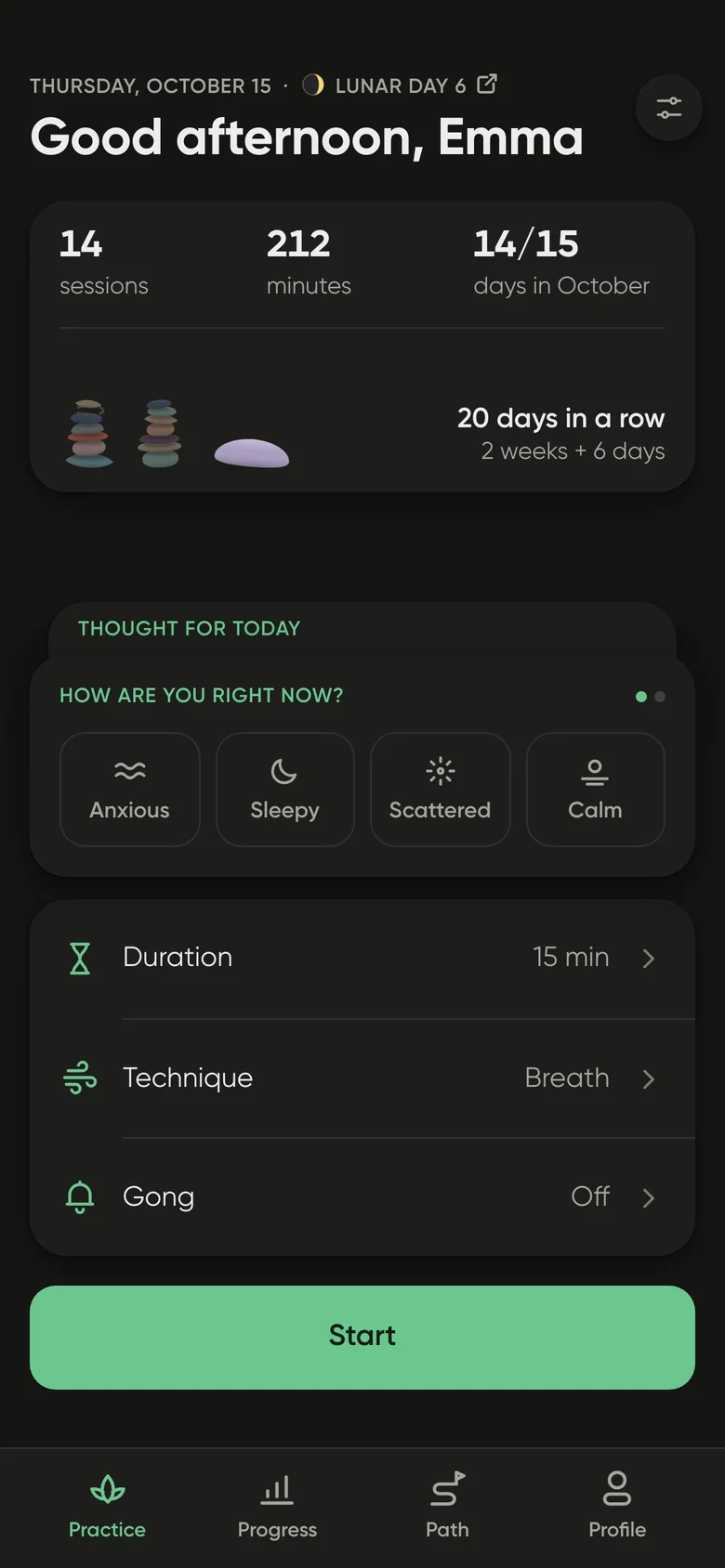
MYZA is a meditation app: a timer with gongs, a practice journal, short courses on meditation and Buddhism, and a guide who helps you make sense of your practice.
Was this article helpful?
New articles by e-mail
One letter with a new article every few weeks. No ads; unsubscribe in one click.
Read also

Oct 21, 2026·15 min read
Upekkha: How to Stop Dancing on Strings Without Going Cold
Equanimity, the fourth brahmavihara, in plain words: how upekkha differs from indifference, where emotional traps come from and why it's the hardest.
 Read or listen
Oct 20, 2026·8 min read·Audio
Mudita: Sympathetic Joy You Can Give
Mudita in plain words: not just being glad at others' success, but actions that multiply clean joy in others — and how to practise sympathetic joy.

Oct 19, 2026·16 min read
What Is Compassion: Not Suffering Along, but Helping
What is compassion? Not an emotion but an action. Three kinds of empathy, how compassion differs from pity, and how not to get hooked by guilt.